Showing posts with label eco-horror. Show all posts

Saturday, April 18, 2026

The Lake By R. Karl Largent

The Lake
By R. Karl Largent
1993 Leisure
Paperback, 365 pages


                I normally do not like books written in first person narrative. Especially in horror books. I mean, you know right away that the storyteller survives. And if that main character is a bit of a smarmy, self-important twat, then it makes it even harder to dig in. I got over it and let the story evolve but I never really liked Elliot Wages.

                Mr. Wages is an author spending the summer in a small vacation town where he somehow becomes the most popular resident. He dates the town’s most beautiful woman, and he has the respect of most of the population. Despite a less than average summer season, the town of Jericho is bracing for the upcoming Jubilee, when tourists will flock to the town’s lake for fun and frivolity. BUT (yes, there is always a big but), there have been a couple of missing or mutilated kids, an oversized, mutant gar, a mysterious fog, and a permeating odor… should the Jubilee actually take place? Holy Jaws, Batman!

                OK, despite the wonderful cover, The Lake is not a Creature Feature story. Yes, there are a few outsized, aggressive gar, but the real danger is that fog. It seems that a factory on the lake is releasing some deadly shit into the water and it’s mixing with some other shit and making a flesh melting fog. OK, I’m still interested.

                At 365 pages, this book is far thicker than I usually like to delve in to and somewhere around the half-way mark, it became quite a slog. But I soldiered on and by the last quarter of the book, I’ll be goddamned… it got pretty damn exciting. After learning that it wasn’t going to be about bloodthirsty gar, I was a bit disappointed, but it really turned out to be a pretty good thriller. Not a horror novel by any stretch, but a tight, suspenseful nail-biter. Largent has a number of actual horror novels under his belt, so I’m looking forward to checking some of them out.

                As long as they’re not written in first person…

Sunday, March 22, 2026

Feeding Ground By John Monsees

Feeding Ground
By John Monsees
2025 Grindhouse Horror
Paperback, 232 pages


                How to review a book that is dedicated to me and my friend Eric Wright, the guy who got me started on reviewing paperbacks? Easy! I’ll just review it. Mr. Monsees is a friend, but I can be objective. But he does write directly to my tastes so he always gets glowing reviews! He, along with Hunter Shea, absolutely get it! And yes, the author acknowledges that this book is an unofficial Guy N. Smith crab book and he really gets the flavor down perfectly.


                The seaside town of Saltwick in North Yorkshire, England is in deep shit. The fish processing plant has contaminated the water with industrial runoff and it has made the local crabs bigger, more aggressive and smarter. After an attack in that very plant and a few missing vacationers, surely they’ll call off the town’s annual festival! No, the mayor wants to cover it up, in true Larry Vaughn style and that puts every townsperson and visitor in even deeper shit. Giant razor-sharp claws shred, dissect and inspect the many humans who go down in a pool of red. These crabs not only destroy humans, but they’re also studying them, learning how to take over the world to become the top species. In all honesty, seeing what’s going on in the US these days (March 2025), I should think they’d do a better job.


                A lesser author would have saved up the festival massacre for the climax but Monsees throws us to the crabs in the middle of the book, stranding our main characters (and plenty of crab fodder) in unsafe buildings and stores and eventually, the labyrinthine tunnels under the city where they’re still very much prone to attack. The crabs had been rebuilding these tunnels for decades. Scientist Emma Carlisle, drunken fisherman Jack, factory worker Danny and others are the  town’s last chance. But good luck, because the crabs are using tactical intelligence, cutting off escape routes, rounding humans up into kill zones. See? I told you they were smart.


                This book delivers everything you would want and hope for, and more. Obviously, we come for the gore and Monsees never disappoints in that respect. Entrails spill, blood sprays and limbs are severed. The gore is deliciously rendered with prose that would make Ramsey Campbell proud. Monsees, an American, serves up a British flavor that rings true to my eyes (admittedly, also American). Top shelf writing all around, though I must confess that I thought the word “systematically” got a little overused when describing the crabs’ intelligent actions, but I guess there’s no better word for it. In truth, I felt that the last third of the book lapsed a little into information overload and some repetition. Not that the climax isn’t thrilling but for a few chapters working towards the end, things felt a little bogged down.


                But that’s just a small bit of nitpicking. This book is to be relished right up alongside the GNS crab literature and I plan on filing it in the crustacean section of my library with those classics. If you haven’t yet checked out John Monsees’ writing, do yourself a favor and dig in. I can guarantee a good read.

Monday, February 23, 2026

Mantis By E.B. Stambaugh

Mantis
By E.B. Stambaugh
Futura 1989
Paperback, 288 pages


                Of course, every book pales in comparison to Pierce Nace’s incomparable Eat Them Alive, but having a go at another giant mantis book takes a lot of guts. E. M. Stambaugh, whoever you are, I tip my hat to you for even thinking about it. Mantis is no Eat Them Alive, but it is well-written and despite being overly character-driven, it’s not a bad timewaster.


                Jerrod Rudd is the Chief of Police in Pleasant Grove, California, a sleepy town where nothing much happens. His marriage is in shambles. He doesn’t have time for his wife, his kids or anything but his job. His annoying Godmother, who raised him, gives his annoying daughter a small Praying Mantis for a science project and the child learns all about her new pet. Meanwhile, the quiet town is besieged by animal slaughters: some dogs, some horses, and then an all-out bloodbath in the local animal shelter. No tracks are left behind and the point of entry to the shelter appears to have been from the skylight.


                OK, being that the book is called Mantis and there’s a big Praying Mantis on the cover, we know what’s going on. It sometimes gets a bit tedious waiting for Rudd to sort things out but the information that trickles in is interesting. Bite marks get larger as time goes on, suggesting that whatever is responsible is growing. Unfortunately, his Godmother is a wannabe detective, and she gets super annoying, talking to the press and such. Like Rudd, I wanted to punch her. Much of the book is pure soap opera, with the husband/ wife problems and the big city detective, her old flame, brought in to help. Luckily, the writing is excellent, and I never drifted off, but I was constantly thinking get to the Mantis part!!!


                Once it finally does (like 200 or so pages in), blood flows and I was happy. It seems that one of the pet mantid’s siblings got radiated in the local toxic waste dump and grew and grew. I always thought those mantis egg cases that you can buy for your garden were a bad idea. True fact: most of those egg cases in garden stores are Chinese Mantids. Thus, you are introducing an invasive species when you’re trying to keep aphids off of your broccoli. Don’t be a tool. Like Clarice, the annoying Godmother.

Thursday, November 6, 2025

Gila! by Les Simons

Gila!
By Les Simons
1981 Signet
Paperback, 166 pages


    By now, everybody knows that Les Simons is actually Kathryn Ptacek, author of many horror and romance novels. Simons is one of her many pen-names and Gila! was her first published horror novel. Having grown up in the Southwest, Ptacek sets a believable tone for this tale of giant, people-eating, mutated Gila Monsters. In real life, despite being called "monsters", Gilas are slow moving animals and really not much of a threat to humans.

    These radiation-born ones mess up the homo sapiens in a big way. The body count is very high and to a killer-animal reader, that is of the utmost importance. It's not just gore and rampaging reptiles, however; Ptacek manages to squeeze out some pathos, none more than in the visceral fairground scene. (This chapter is so great that it inspired Tom Hallman's paperback cover.) Check it out..

    A mother is relaxing while her five children are enjoying a safe, family friendly County Fair on their own in different spot on the fairground. When the Gilas come, she faces the dilemma: which child to save? Heart wrenching! She makes her decision (a bit of Sophie's Choice there) and... 

        "Hypnotized, frozen, Julia could not take her eyes away. She saw the mangled body of her son fall from the lizard's mouth, saw that only half of it was there and that the upper part of the torso, the shoulders and the head, remained in the lizard's mouth." 

 Hot diggity, that's some excitin' writin'!

    Unlike many animal-gone-amok novels, Ptacek's science isn't completely absurd. I mean, we're dealing with giant Gila Monsters that crave human flesh, created by bombs in the desert. You can't get more 50s Sci-Fi than that, but she obviously knows a good deal about the real-life animal and thus makes a potentially silly idea work. For me, Gila! is one of the finest rampaging reptile reads around. Gore, humor, emotion and action; what more could you ask for? Evidently, Ptacek herself is fond of her first horror novel: for a time, she published a writer's market newsletter called Gila Queen's Guide to Markets, a publication with an eye on the horror and fantasy genres.

    Obviously, I'm not the only fan of this essential tome. Centipede Press released a deluxe, signed hardcover of Gila! and Macabre Ink have issued it as part of their Resurrected Horrors series, both released in 2025. And, of course, you need Grady Hendrix's indispensable Paperbacks from Hell (Quirk, 2017) for many reasons but especially to get a peek at Tom Hallman's rough cover sketch.

                                               
                                                         Centipede Press, 2025

This review first appeared in a slightly different form in Midnight Magazine #1 (MCE 2018)

Tuesday, October 28, 2025

Killer Croc By Grahame Webb


Killer Croc
By Grahame Webb
1982 Fontana
Paperback, 249 pages


                Professor Grahame Webb is a noted zoologist who has specialized in crocodilians for decades and he is well versed in Aboriginal culture, having worked with the people for many years. It seems that when Peter Benechley’s Jaws (1974) became a best-seller, it was irresistible to Webb to put his expertise into a fiction story about an oversized Saltwater Crocodile running amok in the waters of Northern Australia. Published by Aurora Press in 1980, the hardcover was called Numunwari, the name of the sacred crocodile in the story. Obviously, Fontana wanted something with a little more zing and changed the title to Killer Croc and had Wilson Buchanan whip up some Jaws-esque cover art, though it looks more like a swipe of Roger Kastell’s cover art for Creatures (Pocket Books, 1979).


                In Arnhem Land, Oondabund is driving a boat for fisherman, poacher and all around bad guy John Besser when they see a massive, 30 foot crocodile. Oondabund recognizes it as an animal sacred to his people while Besser wants to kill it. Besser goes back for it later and gets two of his mates killed. Now, the croc is a maneater and will have to be destroyed. Steve Harris is put on the case to take care of the beast but he is friends with Oondabund and knows the deal. When the croc heads towards the city of Darwin, Harris is pushed by politician Rex Barrett to destroy the federally protected croc. A cop gets eaten and the shit hits the fan. What to do? Well, Oondabund says capture it. It is his spirit animal, literally.


                Yes, you have all of the necessary characters for an animal attack book, the crooked politician, the bad guy(s) and the good hearted Harris, but you also get a main Aboriginal character and his people and that is a flavor that I had not tasted before. Oondabund’s broken English is well written (and it never got on my nerves like when some authors try to write phonetically) and Webb reveals a lot of the culture to the reader. Best of all, he imparts a ton of knowledge about the crocodiles and the conservation efforts to keep them safe. While most animal attack books show the animal attacking as a monster, Webb (and Harris, who really is Webb, I think) portrays the croc, Numunwari, as a sentient being with every right to live its life.


                For being Webb’s only attempt at fiction, I have to applaud his writing skill. Though it gets a bit long in the third act while trying to catch Numunwari, Webb writes a cracking adventure full of suspense and excitement, with real human characters and a lot of heart. I got miffed when a new character was introduced with 50 pages to go but soon saw the error of my ways; it’s an absolutely essential plot point. The book was adapted into the film Dark Age (Arch Nicholson, 1987) which stayed fairly loyal to the book even while condensing things and rewriting for more action. The exception is Harris’s love interest: in the book it is Oondabund’s (black) daughter while the film has him with a lily white former lover working with the Aboriginal people. Meh!


                 Aurora Press, 1980, Jacket illustration                           Dark Age 1987 VHS, 

                    by Roger Janovsky                                                      Charter Entertainment

Wednesday, October 15, 2025

The Millfield Terror By John Monsees


The Millfield Terror
By John Monsees
2025 Grindhouse Horror
Paperback, 210 pages


                I received an advanced review copy to… review. So here I go!


                The Millfield Terror fits in comfortably with the books released by Hamlyn and New English Library in the Seventies and Eighties but also offers a heavy dose of good ol’ American corruption. It turns out that, even with all mod cons like cellphones and the interwebz, you’re still fucked if mutated nature gets a taste for human meat.


                The brain trust in Millfield, Ohio cut corners and hire a shady clean-up crew to take care of a closed chemical plant but their method makes the local centipedes into human hunting, organized giant monsters. Not willing to admit a mistake was made, the councilman who made the call and his brother, the sheriff, initiate a cover-up, despite what locals have seen. The town is sealed off, dooming the citizens, while a group of four believers with evidence (foreman on the clean-up, a doctor, a former scientist and a paperboy) become wanted criminals because they believe in telling the truth. It’s a mad race to stay one step ahead of the rapidly evolving centipedes.


                That’s the story in a nutshell but this is a multi-layered story with a town rife with corruption and full of really bad choices, really flawed people trying to save themselves and the town, and intelligent bugs who are far smarter than their prey. Monsees’ science all looks and sounds pretty spot on; my own knowledge is with reptiles and amphibians, not etymology, but it all reads plausible to my eyes. A great deal of writing about the town and its legal (and illegal) dealings also ring true. Obviously, a lot of research went into this and the reader is rewarded with an intelligent and more or less believable tale of giant, mutant centipedes feeding on a small town.


The author is a remarkably gifted wordsmith, enjoying some excellent turns of phrases in the vein of Raymond Chandler-meets-Ramsay Campbell. His main characters are all well-formed, behaving believably and the quartet of “good guys” are really worth cheering for. I’m happy to say that, like in our beloved nasties from the past, we get a few small characters introduced just to be bug chow. While the blood and meat does get splattered about and the action is breath-taking, the story really is more about survival, guilt and penance.


                Monsees really deserves to be read by a larger audience. It’s tough for an Indy author to gain traction and his writing really has style and panache that should be seen and enjoyed. Give this one a shot and thank me later. The author is responsible for the cover art as well.

Friday, May 23, 2025

The Woodlice By G.P. Nedloh


The Woodlice
By G.P. Nedloh
2025 Self-published
Paperback, 131 pages


                When I was a kid, I called them Pill Bugs (I still do). I’d also heard Roly-Polies and Sow Bugs. The author of this book introduced me to Chuggy-Pigs. There are over two hundred nicknames for this innocuous isopod, but a woodlouse by any other name is still a woodlouse. Author Graham P. Nedloh is a massive fan of Guy N. Smith and even thanks GNS for the inspiration in the book. Every word in this novella is a tribute to Smith and I found it to be a blast!


                The discovery of a deceased cow covered with woodlice gets Jack Fuller, a gamekeeper in the wonderfully named town of Bramblehurst, and the vacationing Dr. Sarah Brapples (another great name!) on the case. The woodlice, normally herbivores, seem to be eating the flesh of the carcass and are bigger than normal. When a couple of teens are found dead in the same manner, it is clear that there is a real problem in Bramblehurst. And possibly beyond.


                Genetech was developing a hormone to enhance plant resilience, but it seems that it affected other species as well. Like woodlice. So, we have the culprit but just how do you stop something like this? That is Jack and Sarah’s problem to solve. Meanwhile, characters are introduced and eaten, just how GNS would have done. Really, Nedloh checks all of the boxes, and I couldn’t be happier. Inappropriate sex scene? Check! Potential romance between two people who didn’t hit it off at first? Check! Best of all, mutated nature getting the taste of human flesh in all of its gory glory? Check, check, check! This is a valentine to fans of Smith’s work. You and me.


                Nedloh isn’t just aping the Great Scribbler, however. There are plenty of new ideas, my favorite of which is a woodlouse attack on a couple who had just started to peak on an acid trip. A ten-year-old torturing a bird gets a lovely and well-deserved comeuppance that had be jumping for joy. This being his first book, I would say that Nedloh is off to an auspicious start. Hopefully, he will keep at it and bless us with another tome inspired by my favorite author. And I enjoy the word “chitinous”.


                No art credit for the cover. It doesn’t LOOK like A.I. and I hope it’s not because I will not support any book with an A.I. cover.

Monday, February 24, 2025

The Scurrying By Wes Whitehouse


The Scurrying

By Wes Whitehouse
1983 Futura
Paperback, 350 pages


                I’d been after this one for quite a while so when I saw a. cheap one for sale online somewhere, I grabbed it immediately. London gets laid to waste by millions of rats (again). What could possibly go wrong?


                Inside the book, there is a blurb saying that this is Whitehouse’s first novel. Searching on the Interwebz brought up only one other book, GLC - The Inside Story (2000). That is a non-fiction account of one of the government administrative bodies in London, and it sounds dry as hell. Sadly, this book has more bureaucrats and politicians than it has rats at any given time. Coming just a year before James Herbert finished off his excellent Rats Trilogy in 1984, this was a pretty ballsy and stupid idea.


                There has been an uptick in rat sightings and exterminators are noticing the rat-bait going either unnoticed or eaten. That means either the rats know it is poisoned or they have become immune. So, naturally, they head aboveground in search of eats. When they’re hungry enough, humans will be on the menu. They will also spread disease.


                While that sounds all well and good, 80% of the book concerns one department hindering the progress of another department that is trying to solve the dilemma. Politicians are more concerned with looking bad than stepping up to actually help. That all may be very realistic but that is not what one buys a nature-strikes-back book for. We want rats killing people. You get some of that, but not nearly enough. For instance, you get four pages of a minster readying an office for a proper photo-op and two paragraphs for a group of teens getting offed by the rats on a camping trip. The best scene in the book comes from a rabid dog (infected by a rat) who mangles a toddler. (I’ll admit it; that scene is worth the price of admission.)


                For a book that had been on my want list for so long, I found this one to be a massive disappointment. Not only is it misogynistic (I know, many books from the time were, but this really feels like Whitehouse truly thinks that women are merely ornamental) with two lovely women being in love with our hero, the pipe-smoking chief of Environmental Health, but the author seems to really dislike rats and shows a little too much joy in doing them in. If the dying humans got as much ink as the dying rats, my review would be more positive.


                The nifty cover is signed “Gulbis”. Could this be Stephen Gulbis, children’s book artist? I think it might be. But still, James Herbert this ain’t.

Tuesday, August 20, 2024

The Mountain King By George Ernsberger

The Mountain King
By George Ernsberger
1979 Berkeley
Paperback, 250 pages


                I read this book as a teen. In the years since, I couldn’t remember much about it, just that there were snakes, but I do remember that I liked it. I figure that since it has been over 40 years since I last read it, the time was ripe for a revisit.


                Four couples head out for a wilderness weekend to a remote cluster of homes (their own summer cottages) on the side of a mountain in the Catskills. Tranquil, beautiful, and restful. Except for pretty much everyone involved is a douchebag. One husband fantasizes about punching his wife in the face, many of them have had “a past” together, and assholism and cattiness runs rampant. It’s a good thing that during a massive storm, part of the mountain breaks loose and that sends hundreds of confused Timber Rattlesnakes down to make life hell for the humans.


                I have no complaints about the characters all being kind of unlikeable; that just means they are real. Ernsberger gives us an excellent portrayal of a group of damaged people. You know, like we all are. Of course, when the snakes are loose, I really root for them because snakes are better than humans. The Mountain King is a Timber who has been living on the mountain a long time. At roughly 7 feet, he is the king of the den. Ernsberger’s science is excellent and his passages from the King’s point of view are cogent, which is very impressive when writing for an animal who relies on instinct rather than thought.


                I liked the book a lot this second time around, though I’m willing to bet that I only read the juicy parts as a teen. The bickering and yammering between the humans wouldn’t have interested me and the human to snake death ratio is way one sided. Kind of like real life. Humans kill snakes way more often than vice-verse. Even though I’d like a lower snake mortality rate, this is a thrilling and well written adventure tale filled with claustrophobic situations and a feeling of dread and hopelessness.


                This appears to be Ernsberger’s only novel. He had been the vice president of Berkely Books prior to this book’s publication. The only other credits I can find are for two fantasy anthologies published by Avon in the late Sixties where he was the senior editor at the time.

Friday, June 14, 2024

Scorpion: Second Generation By Michael R. Linaker


Scorpion: Second Generation
By Michael R. Linaker
1982 New English Library
Paperback, 158 pages


                New English Library unleashed Linaker’s Scorpion in 1980 and evidently, it sold well enough to warrant this sequel. Well, I thank my lucky stars for that! This book is by-the-numbers nature-strikes-back hokum and for that, I love it. Fast, no bullshit, gore, sex, and nastiness… what more could I ask for?


                A few years after the initial scorpion menace, another Cornish resort town is seeing a rise in death and dismemberment, not to mention some nasty envenomation. Sounds like our old pals the scorpions weren’t completely wiped out after all. And they have evolved: this second generation are bigger and meaner than their boob-munching counterparts from the first novel. They are also dying from an infectious disease that can be passed to humans. Cornwall is, once again, fucked.


                This is the Guy N. Smith crab novel you never read. Linaker merely swaps in scorpions for crabs and scuffling, scratching sounds for click-click-clickety and there you have it. This is a quick, gore-splashed mutant scorpion book that does exactly what you would want it to. Linaker probably knocked it out in a couple of days and, if you have the time, you can probably enjoy it in an afternoon.


                Linaker was (is?) an extremely prolific author who specialized in actions thrillers, notably a slew of Mack Bolan titles, as well as a number of Westerns. I’m not sure how or why he came to NEL’s attention for a few horror novels but thank goodness he did! This book is a perfect antidote to a shitty workday. Just picture your boss getting his bones snapped and his skin split by a four-foot scorpion, his innards slipping out onto the floor. Hell to the yes!

Monday, May 27, 2024

Gwen, in Green By Hugh Zachary


Gwen, in Green
By Hugh Zachary
1974 Fawcett
Paperback, 191 pages


                An eco-horror book with loads of forbidden sex? Sign me up right now!


                Gwen and George are a prosperous young married couple that get a lovely piece of island real estate in North Carolina for a song. There is a growing nuclear power plant across the water from them, but their land was safe and secluded, an idyllic spot for them to build their forever home. Had Gwen, who’d had a lot of hang-ups, mostly sexual thanks to her promiscuous mother, finally found a place to feel safe and loved?


                Between her husband clearing out brush and small trees to make a better view of the pond and the nearby plant clearing for new construction, the flora in the area was taking a beating. Gwen was having a problem with that. In fact, Gwen was becoming more in tune with the plant life in the area than the humans. She put up a front for George and her shrink but things were changing rapidly in her world. Gwen could hear… and feel the thousands of trees falling, the plants being massacred, and she started thinking that it was about time for a little payback…


                This is a remarkable book. I felt completely in tune with Gwen right from the start. Zachary takes you inside her head with unexpected sensitivity and clarity and as she changes, you follow as her story becomes a sad, twisted dreamworld. Shockingly, to relieve the pain of the plant life massacre, she starts fucking strangers, first the meter man, then teenage boys from the nearby town. Yeah, the pedophilia is pretty gross, but Gwen needed many eager pain-relievers. Workmen are also disappearing…


                The book is sometimes beautiful, sometimes repulsive, but it always casts an eye towards nature, who couldn’t speak for itself until Gwen came to them. Valancourt Books has reissued the book as part of their Paperbacks from Hell series and thankfully have kept the original cover art, painted by George Ziel. The painting is a haunting masterpiece, just like the book.

Sunday, March 3, 2024

Croc Attack By Brian Gatto


Croc Attack

By Brian Gatto
2022 Raven Tale Publishing
Paperback, 188 pages


                When I see there’s a book called Croc Attack, you bet your sweet ass I want to read it. The author mentioned it on the Books of Horror Facebook page, putting it on my radar, and since it is reasonably priced, I grabbed a copy.


                A group of twenty-something conservationists head into the Everglades to tag some animals, take some samples and, in general, do science stuff. This rubs some of the locals the wrong way (damn tree-huggers) but even worse is the thirty-seven-foot Crocodile that has started to make itself known. The book does exactly what it promises; there are loads of Croc attacks as well as inappropriate sex. Gatto is obviously a fan of 80s pulp horror and knows what is required for a book of this type.


                The characters don’t really matter; it’s a case of set ‘em up and knock ‘em down, which I am a fan of. To an almost comical point, all of the women are stone cold gorgeous, but if I can suspend disbelief for a 37-foot Croc, I have no trouble doing the same for every woman in the book who is a perfect 10 with a huge rack. No wonder everybody is so horny! People hook up left and right and some think about sex even as they are about to be chomped.


                The main storyline is similar to Numunwari (aka Killer Croc) by Grahame Webb and the film Dark Age (1987), which is loosely based on Webb’s book. Coincidentally, there is even a common surname of Darwin in both books. Croc Attack isn’t as gory as I wanted for the first two thirds of the book, with the Croc relying more on stealth, but towards the end, the kills get juicier.


                Like almost all self-published works, another pass at editing could have helped. There are a few sentences I would have reworked, and some word changes I would have done. (Yes, the mouth is cavernous, and the hide is scale-laden, but both terms were used too often.) Also, ecosystem, not echo system. These quibbles don’t put me off, they just bug the editor in me.


                I admit that I got a bit confused near the end when the action is told from a few different perspectives. Still, I will keep an eye out for this young writer. He has a good sense of humor on display and seems to have his teeth in the right place.

Friday, November 17, 2023

Night Killers By Richard Lewis


Night Killers
By Richard Lewis
1983 Hamlyn
Paperback, 208 pages


                I love Richard Lewis. He never lets me down. He jumped on the nature-strikes-back bandwagon in the late 1970s and knocked out a bunch of excellent horror novels. He wrote TV and movie tie-ins under his real name Alan Radnor, but his horror books as Richard Lewis vault him deep into my heart, right there alongside Guy N. Smith.


                Night Killers is a gruesome novel about cockroaches that develop a taste for human flesh. The origin of their dietary change opens the book in very gruesome fashion, with a serial killer’s poor disposal of a victim’s body. This whole opening is a grueling, gory, and exciting scene and eventually leads us to another excellent horror set piece. It’s not until 30 pages in that we meet our main characters. Like most of the great eco-horror novels, Lewis sets ‘em up and knocks ‘em down… the deaths are gruesome and harrowing. Much to my delight, there is a scene with a toddler… no, he wouldn’t go there… Yes. Yes, he did. I am a big fan of “nothing is sacred” horror.


                Taking place in a seedy section of London, Sally is in charge of Unity House, a hostel for alcoholics and vagrants; a place for them to stay and be safe. Her boyfriend David, a reporter (I know, an oft used trope) might have stumbled on a big story here in the East End. Main characters or not, Lewis puts them through the paces, and you never know if they’re going to make it to the end or not. The book never lets up with grisly roach killings and claustrophobic situations of hopelessness. Except for a gratuitous rape scene (really, hadn’t she been through enough already?), I have no complaints at all about the savagery Lewis ladles on.


                While I enjoyed every moment of this book while reading it, perhaps it is telling that when I sat down to write this review a few weeks later, I didn’t remember it very well. I had to skim through and reread it a bit to remind myself what it was that I liked so much about it. Even though it evidently didn’t stick with me, I loved it as I read it and gleefully recommend it.


Midnight Magazine

Books of Horror Facebook Page

Friday, October 6, 2023

Killer Pack By Albert Herbert and Roger Myers


Killer Pack
By Albert Herbert and Roger Myers
1976 Manor Books
Paperback, 221 pages.


                “This book is really poorly written,” thought Mike as he read Killer Pack.


                It really is. It took two authors to write this one and they obviously didn’t have the heart to tell each other that neither one of them could actually write. One of the most jarring things for me was the endless quotation marks for inner thoughts. I was all like, who are they talking to? Oh… it’s a thought. Now, that’s not technically a writing error but it is endless and really could (should) have been done differently. Choppy sentences abound, as well. A sentence for every action… He got into the car. He started the car. He drove the car to the store. He got out of the car. He chose a shopping cart. He went into the store. He selected his groceries. He went to the checkout. The total for his groceries was $20. (That’s only a slight exaggeration.)


                OK, this book came out the same year as David Fishers’ infinitely superior The Pack and shares the springboard of vacationers getting dogs for the summer, then abandoning them when vacation is over. That’s some sick shit, but it makes for some good killer dogs.


                A vacation town in Long Island is having a problem with a pack of rogue dogs. People are getting killed. What is everybody going to do about it? That is the crux of this story; not the killer dogs but what the town officials are planning to do about it. Town Supervisor Diana Wentworth is tough as nails and won’t budge on her No Leash Law. An up-and-coming candidate for her job wants to enforce one. (He’d get my vote… leash your dogs in parks, asshole.) Obviously, as attacks happen, Ms. Wentworth’s platform goes to shit.


                Yep, that’s pretty much what the book is about. The dogs become secondary. But despite the absolutely abysmal writing and lackluster action scenes, it’s really fairly enjoyable. It was good to see a strong, if fallible, woman in a position of power and thoughtfully constructed gay characters. Both of those things are rare in Seventies pulp horror novels.


                I almost want to read this duo’s other book The Last Survivor just to see if it’s as badly written. I would also probably read Myers’ solo release from 2010, Werewolf: A Gay Romp. Just because.


Midnight Magazine
Books of Horror Facebook Page

Saturday, September 16, 2023

Bonegrinder By John Lutz


Bonegrinder
By John Lutz
1980 Berkley
Paperback, 232 pages


                No, perv, this isn’t a porno, it is an early novel from John Lutz, who went on to be a very successful mystery writer, author of Single White Female and an Edgar Award winner. Like so many animal-attack books, it came in the wake of Jaws, and it certainly wears it’s influence on its sleeve.


                There seems to be a monster in the lake in a small resort town in the Ozarks. There have been a few gory deaths and sketchy descriptions and that is enough to cause a lot of excitement in this remote setting. Tourists, news people and gawkers crash the scene, hoping to get a glimpse of the newly coined “Bonegrinder” or, better yet, one of the monster’s bloody victims. That’s more than Sherriff Wintone can take, and he struggles to maintain the peace and his own life in the midst of this Crypto-Craze.


                I don’t know. I guess this was a pretty good book; certainly, it is well-written, but most of the characters are somewhat annoying. The sheriff is pretty much likeable, though he’s written with such a laid-back delivery and colloquialisms that I struggled a few times. Of course, he is the Sherriff Brody of the story, but I kept picturing him as Richard Farnsworth in Misery (1990) due to the writing of the character. Of course, Farnsworth was far older than Wintone was supposed to be, so it made the love interest scenes a bit jarring. And, like the sheriff, I wanted to smack the town drunk in the face.


                All in all, the book felt a little overlong for me and the holding off (and holding off and holding off) on the reveal of the monster made me impatient. I can see how Lutz became adept at mysteries. I figured out one side-plot quickly, so I was pleased with myself. It’s not a bad book and I don’t regret the time I spent with it, but it didn’t completely satisfy me.


Midnight Magazine

Books of Horror Facebook Page

Wednesday, August 30, 2023

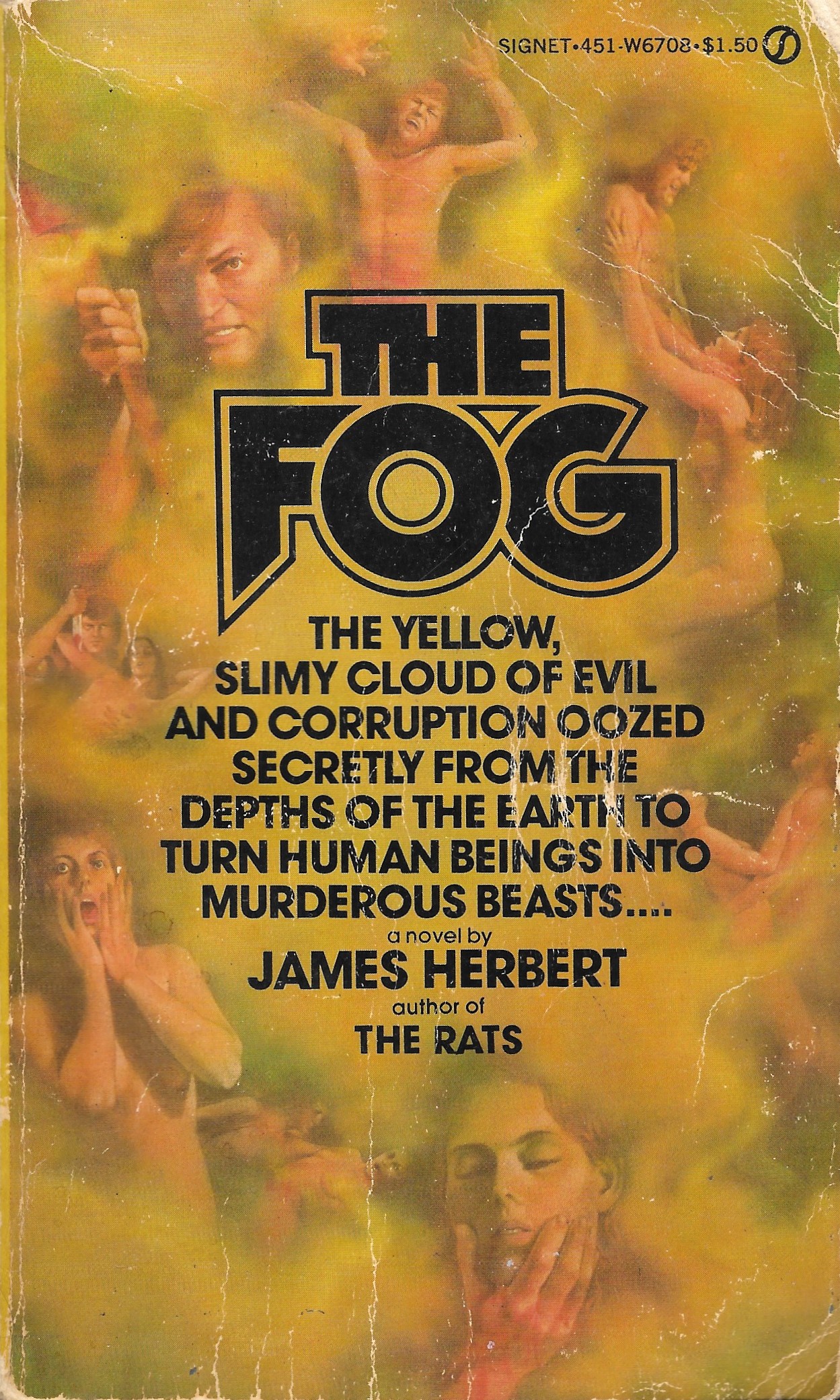
The Fog By James Herbert


The Fog
By James Herbert
1975 Signet
Paperback, 275 pages


I’ve voiced my opinion that James Herbert tends to over-write in the pages of Midnight before, so I’ll just leave that here and shut up.


The Fog is Herbert’s first follow-up to his masterful The Rats and the first half of the book is pure, batshit crazy Herbert greatness. A fissure erupts in the middle of a small town, sucking half of the buildings and inhabitants into it. If that’s not bad enough, the rift also releases a yellowish fog, a mist that when it comes in contact with a person, it makes them insane. Suicide, murder, rape and all sorts of nasty behavior is lovingly depicted, and the fog grows bigger with every mind it destroys. Naturally, it’s headed toward London.


The set-up to this story is superb and the descriptions of the fog’s effects are gruesome and horrific. I’d have been happy with another 100 pages of just that. I don’t need an explanation or any science; just give me the mayhem. But we do get the reason behind the fog and the main character (a survivor of the fissure), and his crew of bigwigs try to solve the dilemma. Herbert is a good enough writer where he won’t leave you high and dry while they seek answers. There are exciting and dangerous treks through the fog while the crazy Londoners who are out of control lurk around every corner.


Herbert revisited some of this idea in his later book The Dark, though that had a supernatural bent. This one gets a little bogged down in the second half, but is still a highly recommended classic. I have the attention span of a tsetse fly and that might be why I started to lose interest while I awaited the finale, but for those of you with more brain in the pan than I, it might be (or become) a favorite.HerbertH


Midnight Magazine

Books of Horror Facebook Page

Friday, July 14, 2023

Bats By William W. Johnstone


Bats
By William W. Johnstone
1993 Zebra Books
Paperback, 348 pages


                Seemingly out of the blue, massive hordes of flesh-eating bats descend upon a normally quiet parish in the-middle-of-nowhere Louisiana. Luckily for all involved, macho he-man Johnny MacBride, rough and ready military intelligence bigwig, made an early retirement to settle there. With Johnny on humanity’s side, there is a chance, however slim.


                OK, yeah… right off I had a hard time with this because the main character is an adult named Johnny, and he was supposed to be badass. Whatever. At least the book starts off right away with the gory bat-attacks and never really lets up. Johnny is pretty much a cartoon, with everyone in law enforcement kowtowing to him and being in awe of his manliness, but there’s enough bat action throughout to keep you going. In addition to the bats themselves, victims of bat bites who do not die quickly become rabid spreaders of the deteriorating disease and lots of smooshy fun is to be had there. If the bats don’t get ya, the rabies-folk will!


                I liked the book, but a lot of it bothered me. Firstly, if Johnstone could have kept his politics and classism out of it, it would have been a smoother read. I have no problem with characters having a political preference but too much of it reads like Johnstone’s angry personal agenda. He does it in most of his books, though, so I should be used to it. There is a prevalent sense of humor throughout, which I like, though sometimes it was a bit too “nudge-nudge-wink-wink, aren’t I being funny” ... (a redneck character is named Billy Joe Harry Bob).


                Overall, the gore is good, the bats are formidable and despite Johnstone’s eccentricities, the writing is decent. In my opinion, about 100 pages could have been culled and it would be a much more satisfying read. And Johnny? Come on… you might as well have named him The Fonz. Couldn’t he have been called Walter or something?


    As always, a nice cover by Richard Newton.


Midnight Magazine

Books of Horror Facebook Page

Saturday, September 3, 2022

Flowers of Evil By Robert Charles


Flowers of Evil
By Robert Charles
1982, Bantam
Paperback, 200 pages


I love nature when it strikes back. Of course, animals killing humans is the best but let’s hear it for the flora that gets into the action as well! A lesser-known entry in the plant-panic pantheon is Flowers of Evil and it’s a worthwhile read.

Some odd little flowers are discovered near a nuclear fallout zone in Russia and one of the research team grabs a couple of the pretty blooms. She gives one to her seafaring brother before she realizes that they are nourished by blood and very capable of getting it. The plant’s seeds are eventually sent adrift, only to plant themselves on a remote island where a troubled family is stationed for the season. So, we get a bloodthirsty plant epidemic in two places simultaneously.

Robert Charles (aka Robert Charles Smith and Robert Leader) primarily writes thrillers, but he does a great job with this eco-horror entry. It’s not overly graphic but the story development and the characters keep the pages turning and the plants are formidable foes, growing larger with every drop of blood. One thing that really struck a chord with me, an amateur naturalist, was that the remote island was a resting spot for migratory birds, and the plants were decimating the populations as they landed, making the island a tangled, evil mess.

Not as grisly as many horror pulps from the same period, but this is a compelling and well written book that can still be grabbed on the cheap.

This review originally appeared in Midnight Magazine #9, March, 2022.

Midnight Magazine
Books of Horror Facebook Page