Wednesday, July 31, 2024

The Son of the Werewolf by Guy N. Smith


The Son of the Werewolf
by Guy N. Smith
1978 New English Library
Paperback, 124 pages


                The end of The Return of the Werewolf lets you know that this one was forthcoming, and it does not disappoint. At 124 pages, there is no time to be anything but a fast-paced page turner to be devoured in an afternoon.


                Margaret Gunn, pregnant after an assault from the baddie from the previous book, gives birth to Hugh, an ugly baby whose third finger on each hand was longer than the rest. A sure sign of a werewolf. He is an outcast, hated in school and in the town and he likes it that way. And then he committed a murder and was jailed. It was while incarcerated that he discovered his own secret, his lycanthropy.


                After his release, the book follows ugly Hugh as he leaves his home and goes out on a blood-drenched road trip. GNS gives us what we all love in his books; blood, guts and some “oh no he wouldn’t” sexual situations. Gordon Hall returns from the previous books and tells us some legends that come in handy for the denouement of the book. He also gives us some words to live by… “You can never be sure of anything where werewolves are concerned”. Indeed not. Cover art by Bill Francis Phillips.


                This book ends the trilogy that started with Werewolf by Moonlight. All three books have been collected into Werewolf Omnibus (Sinister House, 2019), along with a short story. As the original New English Library books have become pretty expensive, the Omnibus seems like a pretty good way to go if you want to read these. And you should read these.


Update: Black Hill Books have recently reprinted this title with a killer Mike McGee cover, so you can forget about all of those expensive originals. 


Black Hill Books, 2025
Cover art by Mike McGee.


Thursday, July 4, 2024

Spore 7 By Clancy Carlile


Spore 7
By Clancy Carlile
1979 Avon Books
Paperback, 280 pages

                This one had been on my shelf for a long time. Every once in a while, I’d pick it up, think it looked great, then start a different book. I finally gave this one the green light and it turned out to be a pretty satisfying experience. Not perfect, but good.

                It starts right off and hits the ground running. A disease is running rampant in Mendocino, California. People are losing their shit, going feral and becoming slime mutants. What caused this to happen? Germ warfare? Outer space meteor shit? Something far more sinister? All of these theories are pursued, and a case could be made for any of them. But while everyone tries to understand and solve the problem, the disease is running rampant, spreading like wildfire, and time is of the essence.

                The military move in and block off the area but as always, things aren’t that easy. If it sounds to you that a lot of meetings with scientists, doctors, generals, and the president take place, you’re not wrong, but it never drags the story down too much (I’m looking at you, Edward Jarvis’ Maggots). Carlile manages to keep the reader interested and emotionally invested as the mystery is unraveled.

                One point to nit-pick… the main character, a middle-aged doctor, is romantically linked with a 19-year-old girl. At no point in the story does her being almost underaged come into play; she could just as easily have been 25. To me, her being just 19 speaks more to the author’s wish-fulfillment than anything else.

                That aside, Carlile delivers a page turner with an ending that plays like an intense 80s action flick. Some might find it preposterous, but I found it fun and exciting. This is the only novel by Carlile that would interest me. He is best known for the book, then screenplay, to Honkytonk Man, the 1982 Clint Eastwood film.

Friday, June 14, 2024

Scorpion: Second Generation By Michael R. Linaker


Scorpion: Second Generation
By Michael R. Linaker
1982 New English Library
Paperback, 158 pages


                New English Library unleashed Linaker’s Scorpion in 1980 and evidently, it sold well enough to warrant this sequel. Well, I thank my lucky stars for that! This book is by-the-numbers nature-strikes-back hokum and for that, I love it. Fast, no bullshit, gore, sex, and nastiness… what more could I ask for?


                A few years after the initial scorpion menace, another Cornish resort town is seeing a rise in death and dismemberment, not to mention some nasty envenomation. Sounds like our old pals the scorpions weren’t completely wiped out after all. And they have evolved: this second generation are bigger and meaner than their boob-munching counterparts from the first novel. They are also dying from an infectious disease that can be passed to humans. Cornwall is, once again, fucked.


                This is the Guy N. Smith crab novel you never read. Linaker merely swaps in scorpions for crabs and scuffling, scratching sounds for click-click-clickety and there you have it. This is a quick, gore-splashed mutant scorpion book that does exactly what you would want it to. Linaker probably knocked it out in a couple of days and, if you have the time, you can probably enjoy it in an afternoon.


                Linaker was (is?) an extremely prolific author who specialized in actions thrillers, notably a slew of Mack Bolan titles, as well as a number of Westerns. I’m not sure how or why he came to NEL’s attention for a few horror novels but thank goodness he did! This book is a perfect antidote to a shitty workday. Just picture your boss getting his bones snapped and his skin split by a four-foot scorpion, his innards slipping out onto the floor. Hell to the yes!

Friday, June 7, 2024

The Mad Death By Nigel Slater


The Mad Death

By Nigel Slater
1983 Granada
Paperback, 256 pages


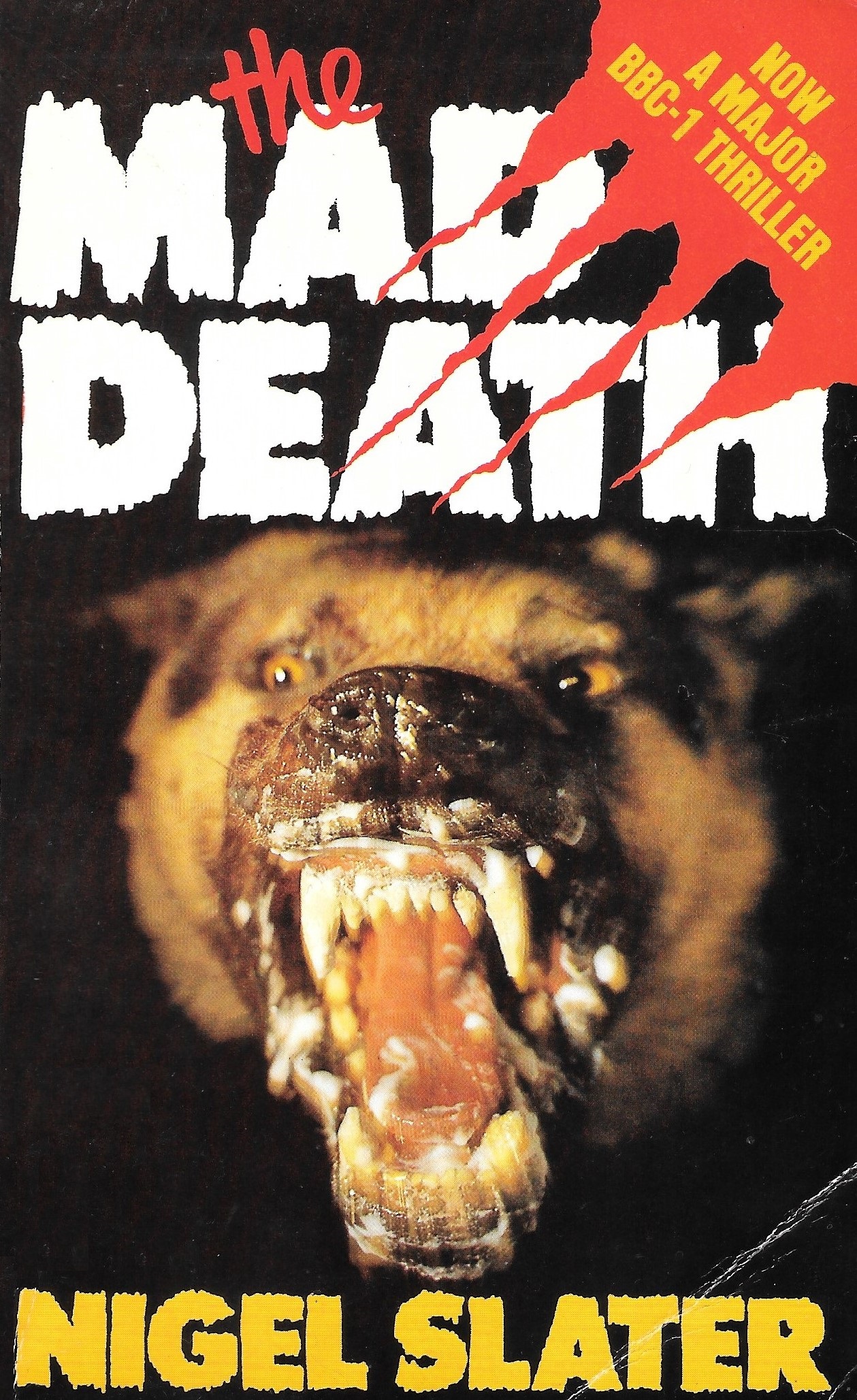
Rabies in Britain? Not again! Remember David Anne’s Rabid (reviewed in Midnight Magazine #4)? Remember Jack Ramsey’s The Rage? Yes, it had been done before (both aforementioned books were published in 1977) but like a moth to a flame, I keep coming back for more.


This one starts with a cat, then a fox, then...a possible epidemic. Our hero, Viv Tait, is a veterinarian with a bad attitude. It seems that he likes animals a lot more than humans. In the scene where we meet him, he is wearing a “Gerbils Role OK” T-shirt. He is short tempered, straight talking with no filter, and dour. He is an asshole. I immediately related to him. Against his will, he is made the head honcho in the war against rabies, entrusted to save Britain from the encroaching epidemic. His assistant is a smart and crafty woman named Penny, who he considers more worthy than her name, so he calls her Tuppence, a moniker that sticks for the rest of the novel. They have a complicated relationship that is aggravating and rewarding at the same time.


Despite the cover and its back cover blurbs (“When you go down to the woods, pray that the Mad Death is more than a snarl away”), this is much more of a thriller than a horror story. The gory details and the infected humans are few, but the dire circumstances and the well-formed characters keep the pages turning. After a lull in the middle, I was back at it, frenziedly reading to get to the end, which admittedly was weak. Intentionally. Because, as we have all learned from our own pandemic, nothing ever really changes in this world.


This was adapted for a BBC TV mini-series that aired the same year the book was released. As it started filming in 1981, one wonders if the book, its source material, was held back to coincide with the now well-remembered TV show airing. At any rate, the Granada book has lovely cover illustration by John Knights (credited on the back cover!) done in a medium I cannot readily identify.

Monday, May 27, 2024

Gwen, in Green By Hugh Zachary


Gwen, in Green
By Hugh Zachary
1974 Fawcett
Paperback, 191 pages


                An eco-horror book with loads of forbidden sex? Sign me up right now!


                Gwen and George are a prosperous young married couple that get a lovely piece of island real estate in North Carolina for a song. There is a growing nuclear power plant across the water from them, but their land was safe and secluded, an idyllic spot for them to build their forever home. Had Gwen, who’d had a lot of hang-ups, mostly sexual thanks to her promiscuous mother, finally found a place to feel safe and loved?


                Between her husband clearing out brush and small trees to make a better view of the pond and the nearby plant clearing for new construction, the flora in the area was taking a beating. Gwen was having a problem with that. In fact, Gwen was becoming more in tune with the plant life in the area than the humans. She put up a front for George and her shrink but things were changing rapidly in her world. Gwen could hear… and feel the thousands of trees falling, the plants being massacred, and she started thinking that it was about time for a little payback…


                This is a remarkable book. I felt completely in tune with Gwen right from the start. Zachary takes you inside her head with unexpected sensitivity and clarity and as she changes, you follow as her story becomes a sad, twisted dreamworld. Shockingly, to relieve the pain of the plant life massacre, she starts fucking strangers, first the meter man, then teenage boys from the nearby town. Yeah, the pedophilia is pretty gross, but Gwen needed many eager pain-relievers. Workmen are also disappearing…


                The book is sometimes beautiful, sometimes repulsive, but it always casts an eye towards nature, who couldn’t speak for itself until Gwen came to them. Valancourt Books has reissued the book as part of their Paperbacks from Hell series and thankfully have kept the original cover art, painted by George Ziel. The painting is a haunting masterpiece, just like the book.

Saturday, May 11, 2024

The Spirit By Thomas Page


The Spirit
By Thomas Page
1979 Hamlyn
Paperback, 252 pages


                We’ve got a Bigfoot novel here, ladies and gentlemen, and it’s a pretty good one. While it is far from perfect, it is satisfying, a quick read and it delivers the goods. I mean, it pretty much opens with a beheading!


                Two men are tracking Bigfoot across the country. One is John Moon, a Native American Vietnam vet in search of inner peace and to "learn his name", his place in life. Bigfoot is The Spirit that will show him the way. John Moon is pretty much bonkers, by the way. The other man is Raymond Jason, a moneybags adventurer whose prior expedition was marred by a lethal Bigfoot encounter. He seeks not only revenge, but to show the world that the monster exists. Raymond Jason is pretty much an asshole.


                Our two main characters travel state to state, even into British Columbia, tracking the beast. They finally get up close and personal with their quarry at a mountain in Washington state. Luckily for the reader there is a ski resort that has recently opened on Bigfoot’s home base.


                OK, I mean John Moon’s character isn’t exactly enlightened by today’s standards, but I wouldn’t call it completely un-PC. The fact that there is only one female character stands out more for me. Hey, it was the 70s; a grain of salt is often needed. But the story revolving around the two men and their searches is a tight thriller, full of action and I blew through it quickly after deciding (about 50 pages in) that it was pretty good. Some neat ideas about the origin of the Bigfoot species are offered up, as well.


                Page is no stranger to fantastic fiction, having written The Hephaestus Plague in 1973. You know, the one the movie Bug was based on with incendiary beetles? Based on that book and this one, he is OK by me. The Spirit has been re-released by Valancourt under Grady Hendrix’s Paperbacks from Hell banner, so it’s easy enough to find now. And as Hendrix says about The Spirit, it’s a rare Bigfoot novel with absolutely no Bigfoot rape scenes. Yay!


Friday, April 26, 2024

Parasite By Richard Lewis


Parasite
By Richard Lewis
1980 Hamlyn
Paperback, 187 pages


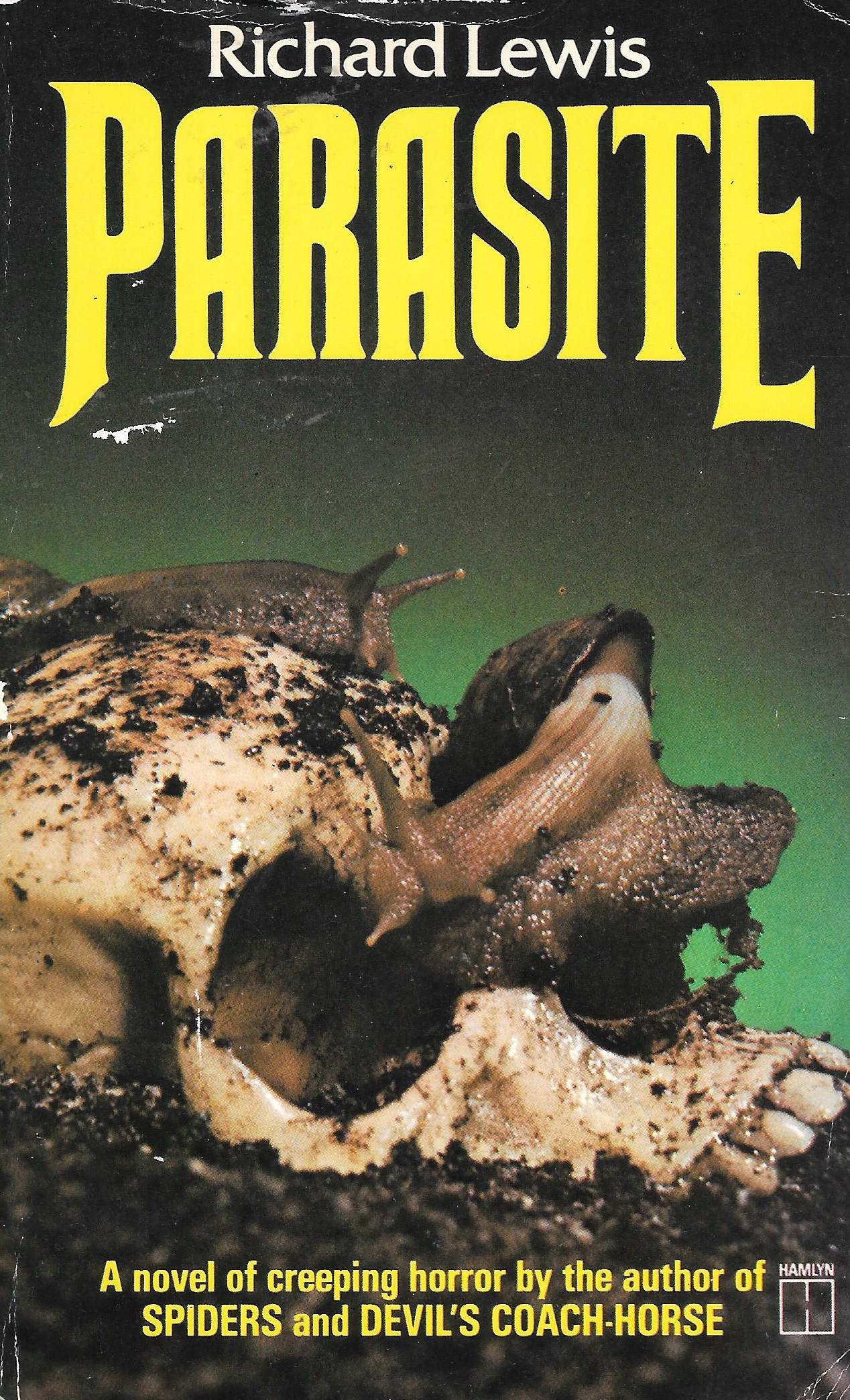
Richard Lewis knows how to handle a nature-strikes-back premise and he proves himself capable once again with another new pandemic horror out to threaten Britain. The parasite in question is a tiny freshwater worm that spreads bilharzia, also known as schistosomiasis. It’s real. Look it up. It is unpleasant. Of course, Lewis’s parasite has mutated a bit to make the disease even more unpleasant. This parasite can cause madness, gooey death and 80s pulp-horror mayhem.


The reader knows what is going on before the characters in the book do and it’s enjoyable to follow them as they uncover the unimaginable. That said, there tends to be a few too many meetings among the doctors, scientists, and politicians for my taste. It doesn’t ruin the book, like it does in Edward Jarvis’s Maggots, but it does slow down the narrative at times. Still, Lewis keeps things moving along and throws us some gruesome parasite action just when we need it.


There is a well written romance between our main character George Carson and his associate Jill Turner. Plus, George’s kid, born of his late wife, catches the parasite which brings a new level of pathos to the story. Of course, in true Lewis fashion (SPOILER), he throws in a late-story rape to show that humans are always the true horror in the world. (END SPOILER). It just seems like overkill, but hey… it fucks with you, and I guess that is the point.


So, while this isn’t the perfect Richard Lewis book (that would be Devil’s Coach-Horse aka The Black Horde), it is still prime 80s Hamlyn Horror and is well worth adding to one’s nature-strikes-back collection. I just wish there had been less meetings in it.